
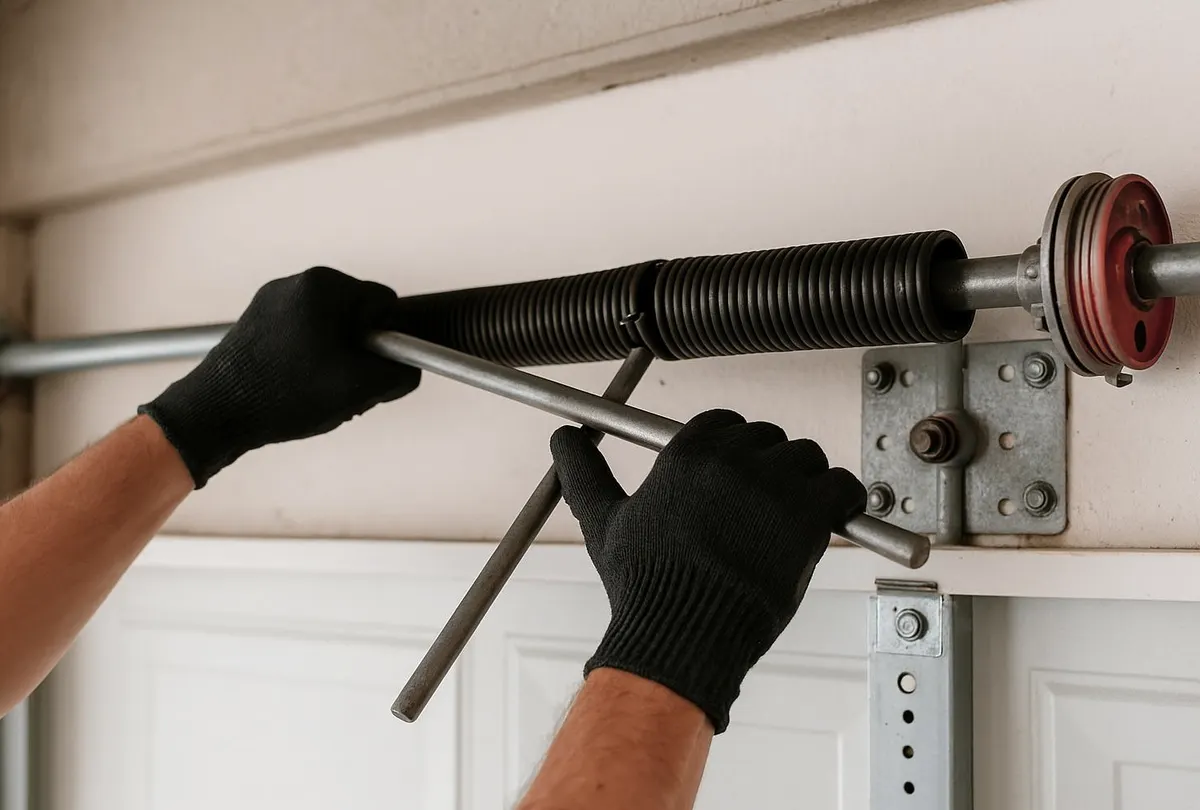
What a Technician Sees on a Typical Spring Call
Most calls about failing springs follow the same pattern this time of year. A homeowner notices the door feels heavier than it used to, or the opener has started making a straining sound right before the door stops short. By the time we pull into the driveway, there's usually rust dust on the floor under the spring, a visible gap in the coils, or a cable that's gone slack on one side. None of that happened overnight — it built up over months of temperature swings, humidity, and salt tracked in from the driveway. The good news is that springs almost always give warning signs before they fail completely. You just have to know where to look.
First, Know Which Type You Have
Garage doors use one of two spring systems, and they wear differently.
- Torsion springs sit on a metal shaft directly above the closed door, usually one or two thick coiled springs mounted horizontally.
- Extension springs run along the horizontal tracks on either side of the door and stretch and contract as the door moves.
The checklist below covers both, with notes on which symptoms matter most for each system.
The Walk-Through Checklist
1. Gaps or Rust in the Torsion Coils
With the door closed, look at the torsion spring above it. The coils should sit tight against each other with no daylight between them. A visible gap, especially combined with rust-colored flaking, means the spring has started to lose tension and stretch. This is one of the clearest early warnings on a torsion system.
2. Stretching or Sagging in Extension Springs
On an extension spring system, compare both springs side by side. If one looks noticeably longer or more stretched out than the other, even with the door closed, that spring is wearing unevenly and losing its ability to hold tension.
3. The Door Looks Crooked When Opening
Watch the door as it opens. If one side rises faster than the other, or the door tilts visibly at any point in the cycle, one spring is doing more work than it should. This is a sign one spring has weakened relative to its partner, which also puts extra strain on the opener and tracks.
4. The Opener Strains, Clicks, or Stops Mid-Cycle
Openers are built to lift a balanced door with springs doing most of the heavy lifting. If yours is groaning, clicking repeatedly, or stalling partway through a cycle, it's likely compensating for springs that no longer carry their share of the load.
5. The Door Feels Heavy by Hand
Disconnect the opener using the manual release cord and lift the door by hand about halfway. A properly balanced door with good springs should stay in place and lift with moderate, even effort. If it feels like dead weight or slams back down, the springs have lost significant tension.
6. A Loud Bang or Pop During Use
A single loud pop, followed by the door suddenly feeling heavier or not moving at all, is often a spring that has already partially failed. If you hear this, stop using the door and treat it as an emergency rather than a minor noise issue.
7. Rust Flecks or Orange Dust Under the Spring
Check the floor and nearby surfaces under the spring assembly. Fine orange or reddish-brown dust is a sign of internal corrosion weakening the steel from the inside, something that's common here given humid summers and salt exposure during winter months.
8. Fraying or Loose Cables (Extension Systems)
Follow the lift cables on an extension spring door down to where they attach near the bottom bracket. Frayed strands, visible kinks, or slack in the cable line up with a spring that's no longer holding consistent tension on that side.
9. The Door Drifts Down After Opening
Open the door fully and watch it for a minute. A healthy system holds position. If it slowly creeps downward on its own, the springs aren't providing enough counterbalance anymore, even if nothing looks visibly broken.
10. Spring Age
Most residential springs are rated for a set number of open-close cycles, which typically works out to somewhere around 7 to 10 years of average household use. If you know your springs are approaching or past that range, treat any of the symptoms above as more urgent.
Why This Wears Faster Around Fox Lake
Big seasonal swings are hard on metal springs. Cold winters bring ice, road salt, and moisture that gets tracked into garages and accelerates rust on coils and cables. Humid summers add their own corrosion pressure, and spring storm season can mean a door cycling more often as people move vehicles and equipment in and out ahead of weather. None of that is unique to one house — it's just the trade-off of garage doors living through real Illinois weather year-round.
When to Call Fox Lake Garage Door
If you've spotted gaps in the coils, uneven lifting, rust dust, or a door that feels heavy by hand, it's time to have it looked at before a full failure happens, often without warning and sometimes while the door is open. Our Spring Replacement service includes inspecting both springs (even if only one looks bad, since they wear as a pair), matching the correct wire gauge and length for your door's weight, and rebalancing the system afterward. If you're not sure what you're looking at, our Garage Door Maintenance visits catch this kind of wear during a routine check, often before you'd notice it yourself.
If any of these signs match what you're seeing in your own garage, give Fox Lake Garage Door a call. We serve Fox Lake, IL and the surrounding area, and we'd rather replace a worn spring on a Tuesday afternoon than respond to a snapped one on a Saturday night.